Loose, rusted or broken railing? Let's get it put right.
One call connects you with an independent local pro for porch, step, stair and deck railings: wobbly posts, rust at the base, broken welds, and new railings made to fit the house.
STL Railing Repair is an independent referral service, not a railing, welding or ironwork company. We connect people in the St. Louis area with independent local railing and ironwork pros, who set their own prices and are responsible for their own work.
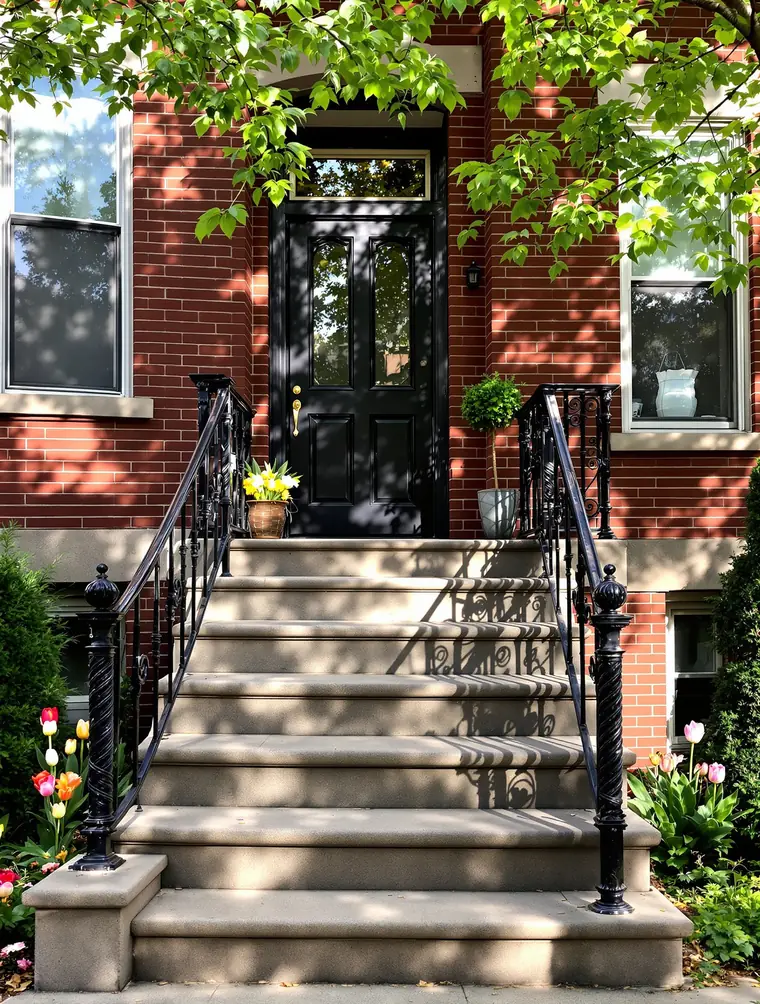
Illustrative photo. A typical St. Louis brick stoop with iron step railings.
Free advice, no call needed
The St. Louis porch & stair railing guide
Four common problems, what they usually mean, when they're a safety issue, and what to note before you call. General guidance only. A pro who sees your railing has the final word.
I
The railing moves when you lean on it
On older St. Louis stoops, a wobble almost always starts where a post meets the step or the brick. Posts were often set into holes in limestone or concrete with lead or grout, and decades of freeze and thaw open that joint up. Newer railings tend to loosen at the bolts or anchors instead.
A loose railing is worth taking seriously even when it still looks fine, because a railing usually fails at the moment someone needs it, like a slip on an icy step.
Is it a safety issue?
Treat it as a safety issue if a post moves more than a little by hand, if you can see a gap or crumbled masonry around the base, or if the railing guards a drop where someone could fall. Until it's fixed, tell family and guests not to rely on it.
Before you call, note
Which posts move, and how much (a short phone video helps)
What the posts sit in: limestone step, concrete, brick wall or wood deck
Whether the step or masonry around the post is cracked
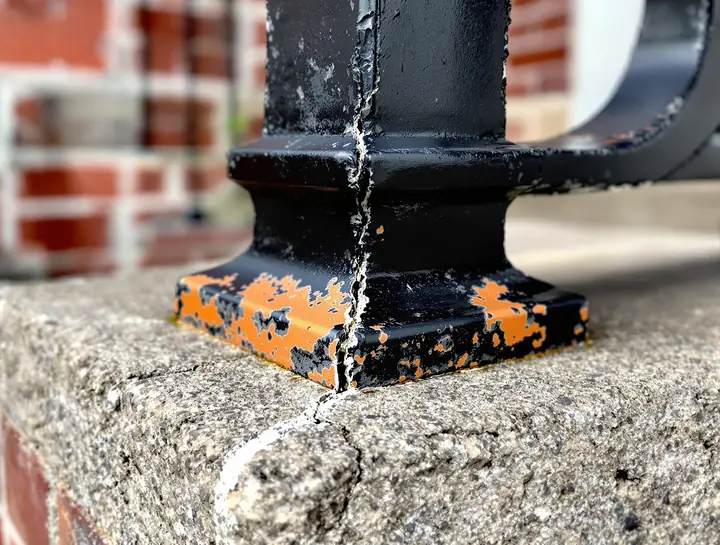
Surface rust is cosmetic: the metal is still solid under the flaking paint, and the fix is cleaning, priming and repainting. Rust becomes structural when it eats the metal itself, usually at the bottom of posts and pickets where water sits on the step, and where the iron is set into masonry and swells.
A quick check: press a screwdriver against the worst spot. If it scratches paint and finds hard metal, it's surface rust. If it flakes through, crumbles, or the post sounds hollow or thin, a pro should look at whether that section needs a new piece welded in.
Is it a safety issue?
Rust that has thinned a post at its base, or swollen iron that has cracked the step around it, can mean the railing won't hold a load. Have it checked before the next winter.
Before you call, note
Photos of the worst spots up close and one of the whole railing
Whether the masonry around the post is cracked or pushed up
Whether you want repair only, or repair plus a full repaint
A broken weld, a missing picket or a snapped scroll
Old railings break in predictable places: the weld where a picket meets the rail, decorative scrolls that get hit by a stroller or a snow shovel, and the end of a handrail where it was bolted to the wall.
Many of these are shop or on-site welding repairs. Matching an old pattern, such as a twisted picket or a cast panel, may mean fabricating a piece, so photos matter.
Is it a safety issue?
A broken weld on the top rail or a post is a safety issue. A missing decorative scroll usually isn't, but loose broken pieces can cut, so remove them if they're hanging.
Before you call, note
Photos of the break and of a matching intact section, for pattern matching
Whether the broken piece is still there
Rough size: how many feet of railing, how many steps
You need a new railing, or one that was never there
New railings are common for front steps that never had one, for a second handrail on wide steps, and for replacing a railing too far gone to repair. Most new iron railings are measured on site, built in a shop, then installed, so expect a wait between the measure and the install.
Some cities around St. Louis require a permit for new exterior railings or stairs, and homes in local historic districts may need exterior changes reviewed. Ask your city first; a pro can tell you what they usually see.
Is it a safety issue?
If steps have no railing at all and someone in the house is unsteady on them, ask about a temporary grab rail while the permanent one is made.
Before you call, note
Photos of the steps from the side and the front
How many steps, and roughly how wide
Any style you want to match (see the field guide below)
Knowing the name of your style helps when matching a repair or ordering a new railing. Tell the pro which plate looks closest, or send a photo.
Pl. 1
Straight picket with collars
The workhorse of South City stoops and post-war bungalows: plain square pickets, sometimes with small collars.
Pl. 2
Twisted picket
Pickets twisted while hot. Common on 1920s-1950s brick homes and often mixed with scrolls.
Pl. 3
S-scroll and C-scroll
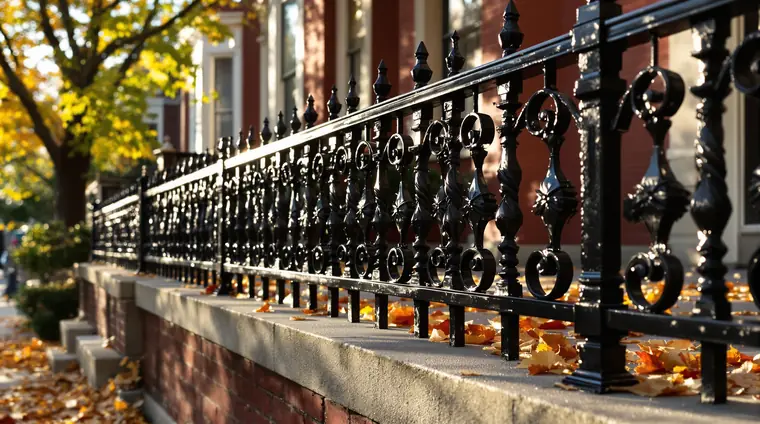
Curled scrollwork between pickets. Matching it is a fabrication job, so photos of an intact section help.
Pl. 4
Basket baluster
Pickets split into a cage shape at mid-height. Found on older porches and some newer decorative designs.
Pl. 5
Victorian cast panel
Arched or medallion panels on older Victorian and Queen Anne houses. Repairs may mean finding or casting a matching piece.
Pl. 6
Modern flat bar or horizontal
Clean horizontal bars or flat stock on renovated homes and new decks. Ask about local opening-size rules.
Illustrative photo. Ornamental scroll railing on a brick porch.
Plan ahead
Want new railings by spring? Start the conversation in winter.
New iron railings are usually measured, then built in a shop, then installed, and spring is when everyone wants theirs. Getting quotes and measurements in late fall or winter puts you ahead of that rush. Urgent repairs happen all year; painting and some masonry wait for dry, mild days.